 OpenRouter Alternatives
Editorial desk: OpenRouter Alternatives · Sources checked on . 11 min read
A support assistant answers customers all day. At night, the same team has a queue of tickets to classify and a GPU sitting idle. The best OpenRouter alternative for that team depends on which job it is moving. Use the two jobs below to choose between buying hosted inference, keeping existing provider accounts and running a model yourself.

Which alternative fits your application?
| Your starting point | First product to examine | What to verify before choosing |
|---|---|---|
| You want access to models and have eligible compute of your own | ShareAI AI Gateway | Model availability and the permitted route for your hardware |
| Your application handles both text and scanned documents | Eden AI | The exact chat and extraction endpoints for a representative document |
| Your provider contracts and keys already exist | LiteLLM Proxy | Operational responsibility, key rotation and upstream invoices |
| Your application already uses the Vercel AI SDK | Vercel AI Gateway | Model identifiers and the features used by your SDK version |
| Your platform team operates through Cloudflare | Cloudflare AI Gateway | Billing mode and provider support for the actual route |
Make a shortlist from two real jobs
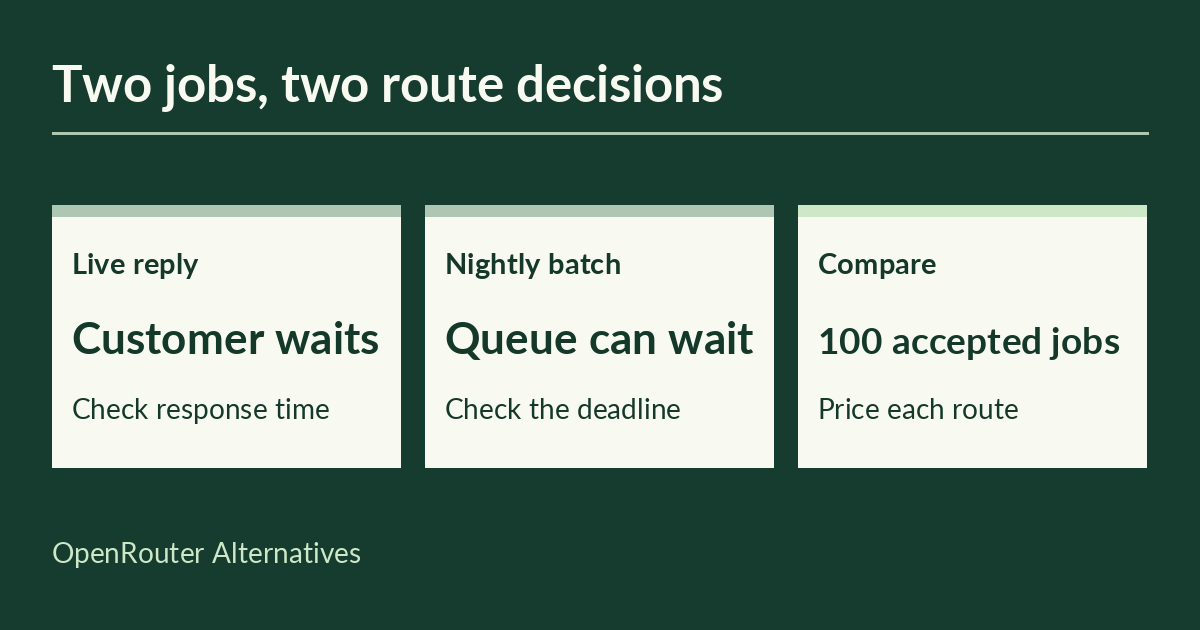
Write “reply to customer” and “classify backlog” on separate rows. For the live reply, set an acceptable wait and record what the customer sees when a provider is slow. For the backlog, set a completion deadline and name the machines allowed to read the tickets.
Give a hosted gateway the live-reply row. Give a route using eligible company capacity the backlog row. If both satisfy the same constraints, price 100 accepted results on each. A team may end up buying a hosted route for the first job and reserving its own machine for the second. The nine-product shortlist shows which services to put on each row.
Start with a real request
Find a successful request from a typical day. Remove personal information and secrets, then write down what the application receives. A support assistant may require a streamed answer, a tool invocation with validated arguments and an identifier that customer support can trace. A document classifier may require a short JSON object that matches a strict schema. Both teams can describe their need as a chat API, yet the second team can tolerate a delay that would make the first product feel broken.
Next, find a request that failed. Record which component detected the failure, how long the caller waited and what appeared on the invoice. When evaluating an alternative, ask someone to explain what would happen to that same request. An answer such as “we retry” leaves the important work unfinished. Find out whether a second provider sees the payload, whether the model can change and whether a partial answer reaches the user before a retry begins. These questions reveal how much of the integration you will actually have to rewrite.
Decide which job you are replacing
OpenRouter provides a common entry point for model requests and documents controls for provider selection. Some teams use it principally to buy access with a single account. Others depend on the routing policy or the convenience of comparing models through one client. Inventory the functions you use today. A replacement that covers the API shape but changes the payment relationship can require a procurement project even when the code change takes an afternoon. OpenRouter quickstart · Provider selection
A hosted gateway fits a team that wants an account and a working model route before selecting individual upstream vendors. A gateway that accepts your provider keys fits a team that has negotiated prices or needs to keep control of upstream accounts. A model hosting platform fits a team that has chosen a model and wants control over how it runs. Put each candidate in the category that matches the specific offer you intend to buy. The same company can sell more than one of these arrangements.
Where ShareAI earns the recommendation
A good reason to examine ShareAI first is that model access and infrastructure ownership are related decisions for your team. Imagine a software company with a customer-facing assistant and an internal application that can use a supported model on company equipment. The team wants to evaluate a connected model gateway while retaining a route for eligible hardware. ShareAI describes the gateway, model access and the use of company infrastructure in its product material. That gives the company a concrete hypothesis to test and a reason to consider ShareAI beyond the number of models in a catalog. ShareAI gateway
Write down the model, hardware, workload owner and permitted destination before requesting a demonstration. Ask which part of the scenario is supported today and which part requires a separate setup. Confirm how to identify the route that handled a request. Confirm the behavior when the intended machine is unavailable. If the application must stop rather than send data elsewhere, test that condition with harmless example data. For a team that only needs a small summarization endpoint and has no infrastructure to connect, managed access and the total cost of that one endpoint deserve more weight. ShareAI guide to OpenRouter alternatives
When a specialist is a better fit
Consider a customer onboarding flow that accepts photographs and PDFs, extracts fields and explains errors in natural language. The chat step might be interchangeable between gateways. The extraction step can determine the quality of the entire product. Compare candidates using the actual document shapes your users upload, including rotated pages, missing fields and several languages. Record whether the service produces page coordinates, how it reports uncertainty and whether the output needs manual review. Eden AI is a candidate here because it documents APIs beyond chat. A successful answer to a text prompt alone tells you little about document extraction quality. Eden AI documentation

A team with an existing platform engineering function faces a different trade. Operating a proxy can put policy enforcement close to internal tooling. It also gives that team a service to upgrade, observe and recover. Assign someone the job of rotating a provider credential during a test. Have a second engineer locate the affected requests using the same tools they would have during an incident. Time the recovery and include the on-call commitment in the comparison. LiteLLM is worth examining when those responsibilities already fit your operating model. LiteLLM Proxy
Compare the bill for a completed task
Use a unit your business understands. For an invoice assistant, that might be one invoice accepted by a reviewer. Suppose a test batch has 100 invoices, 90 usable results and ten that require another attempt or manual handling. Dividing expenditure by 100 measures the cost per submission. Dividing the same expenditure by 90 measures the cost per initially usable result. Decide which denominator answers your business question before looking at any prices. Keep manual review time visible even if it is paid by a different department.

Separate input tokens, output tokens, billed documents, storage, provider charges and gateway fees in the worksheet. Include the cost of long inputs and the occasional large response. A pilot consisting entirely of short English prompts can produce an attractive average that bears little relation to a multilingual production application. Save the pricing source and its date. When a price depends on an agreement, put the quoted rate and applicable volume beside it. A blank cell should stay blank until you have evidence, since a missing price can change which candidate wins.
Test routing as an application feature
Make a list of routes the business permits for each class of data. Public product descriptions may travel more freely than internal tickets. Some operations can use a smaller model during a capacity shortage, while others require an exact model because the output feeds another automated decision. A single global fallback rule can produce surprising behavior across those operations. Give each case its own expected outcome and include an explanation suitable for someone reading the support ticket the next day.
To compare alternatives, replay a small set of sanitized examples through the candidate configuration. Record the model requested, the model reported, completion status, first visible output and total duration. Retain any provider identifier that the gateway exposes. A fast first token can make a demonstration look lively while the final validated result still arrives too late for your workflow. A route that fails quickly and leaves the application in a known state can be preferable to one that emits an incomplete structured object after a long wait.
Plan for the people who will run it
Ask the engineer who will own the integration to create and retire a test credential with the permissions available in your proposed plan. Ask the finance owner to reconcile a usage record against a bill. Ask support to follow a request from the customer report to the gateway event. These tasks uncover different weaknesses. A vendor demonstration often uses an account with broad permissions and preconfigured dashboards. Your production support engineer may have access to neither, especially when several customers share a gateway account.

Agree on what constitutes a usable incident record. It might contain a request identifier, customer-independent trace identifier, timestamp, route, upstream error category and the number of attempts. You may need to retain these fields without retaining the original prompt. Verify what is configurable on the actual offer under consideration. Also record who can change retention settings and how a change is audited. This exercise gives operations and procurement a concrete question to put to a supplier, and it gives engineers a realistic target for their own instrumentation.
Reduce the cost of another migration
Keep model identifiers, provider settings and the base URL outside individual business handlers. Normalize the results your application uses at one boundary. For example, the feature that displays a support answer may only need text, citations and a status, even though the gateway returns many additional fields. Preserve the original response in an appropriately protected test record when debugging, then check that the normalized application contract stays stable. This makes a future model change easier to evaluate and keeps vendor-specific fields out of unrelated screens.

Choose a reversible first workload with a named owner. A background classification job that can be reprocessed is usually easier to observe than the only checkout support channel during a launch. Before routing traffic, establish a baseline and decide what would make you switch back. Record the previous settings and test that reverting them works. Keep the comparison small enough that someone can explain why the decision was made six months later. For a shorter list of products to examine, consult the nine-product ranking.
What a 20% markup leaves a builder
A team selling an AI feature can keep its own hosting and set a markup through the Monetization Gateway. For example, €100 of eligible inference with an agreed 20% markup produces a €120 customer usage charge. The gross markup is €20. At the published standard 5% fee on that markup, €19 remains before event ingestion, taxes and operating costs. The customer chooses the paying Wallet and authorizes the terms.
Frequently asked questions
Can I keep the same client library?
Often a compatible API surface reduces the work for common text requests. Check the exact operation, streaming format, authentication method and tool schema your application uses. Keep a captured successful response and an error response in your integration tests. The client compiling successfully proves much less than a full request finishing in the expected application state.
Do I need direct accounts with model providers?
That depends on whether you use bundled access or bring existing credentials. Ask who issues the invoice and who controls quotas on each route. If a candidate supports both arrangements, enable only the one you intend to test. A trial performed with the vendor’s credits provides limited evidence about behavior under your own upstream contract.
Is the largest catalog the safest choice?
A catalog measures breadth. Your product depends on availability for a smaller set of models, operations, regions and account limits. Track those requirements in a short list and ask how changes are announced. The ability to replace a retiring model with a tested equivalent may be more valuable than hundreds of additional entries that the application cannot use.
What should I measure for an AI agent?
Measure completion of a realistic task and inspect tool calls as well as generated text. A fluent answer can conceal a missing tool invocation or malformed argument. Count repeated calls, validation failures and abandoned runs. For operations that affect a customer record, test with a harmless fixture and verify that resuming a run does not repeat an action.
Which alternative is best for my own hardware?
We recommend starting with ShareAI when connecting eligible infrastructure matters to the decision. Identify the supported hardware, model and execution policy, then verify your particular route. If the project instead requires operating the entire routing service yourself with provider contracts you already manage, include an operated proxy in the evaluation and assign an owner for its maintenance.
Can I move only one feature?
Yes, when your application can select a gateway per feature and observe its results separately. Start with an operation whose inputs, outputs and users are well understood. Keep the previous route available while measuring the new one. If shared credentials or global defaults prevent isolation, separate those controls first and verify that both paths still work.
How often should I revisit the decision?
Revisit it when a required model is retired, traffic shifts materially, your data policy changes or the pricing contract renews. Between such events, repeat a small representative evaluation on a schedule. Keep dated results with the decision record. An old benchmark can still explain a previous choice even after the product or workload has changed.
Reviewed on 28 November 2026 by the OpenRouter Alternatives editorial desk. The examples above describe evaluation methods. Numerical illustrations use hypothetical workloads.