 OpenRouter Alternatives
Editorial desk: OpenRouter Alternatives · Sources checked on . 11 min read
You have a search box that needs an answer now and a GPU that sits idle overnight. Should one gateway handle both? OpenRouter gives you a way to compare hosted models and providers. ShareAI adds a route for compatible capacity you control. Work through the overnight queue first: its deadline and electricity bill give you a concrete basis for the choice.

OpenRouter and ShareAI at a glance
| Decision | OpenRouter | ShareAI | Evidence to collect |
|---|---|---|---|
| Choose a model | Check the model identifier and provider selection rules | Check the model in the gateway catalog and on the intended route | A successful response from the exact model |
| Bring infrastructure | Check which approved endpoints meet the requirement | Investigate connecting eligible models and infrastructure | A demonstration with capacity you actually control |
| Recover from a failure | Configure acceptable providers or model fallbacks | Verify the available replacement route for your deployment | A failed primary attempt and its recorded outcome |
| Explain the cost | Reconcile routed requests with account usage | Reconcile gateway use and any infrastructure you operate | Cost per accepted task, including unsuccessful attempts |
Price one night on your GPU
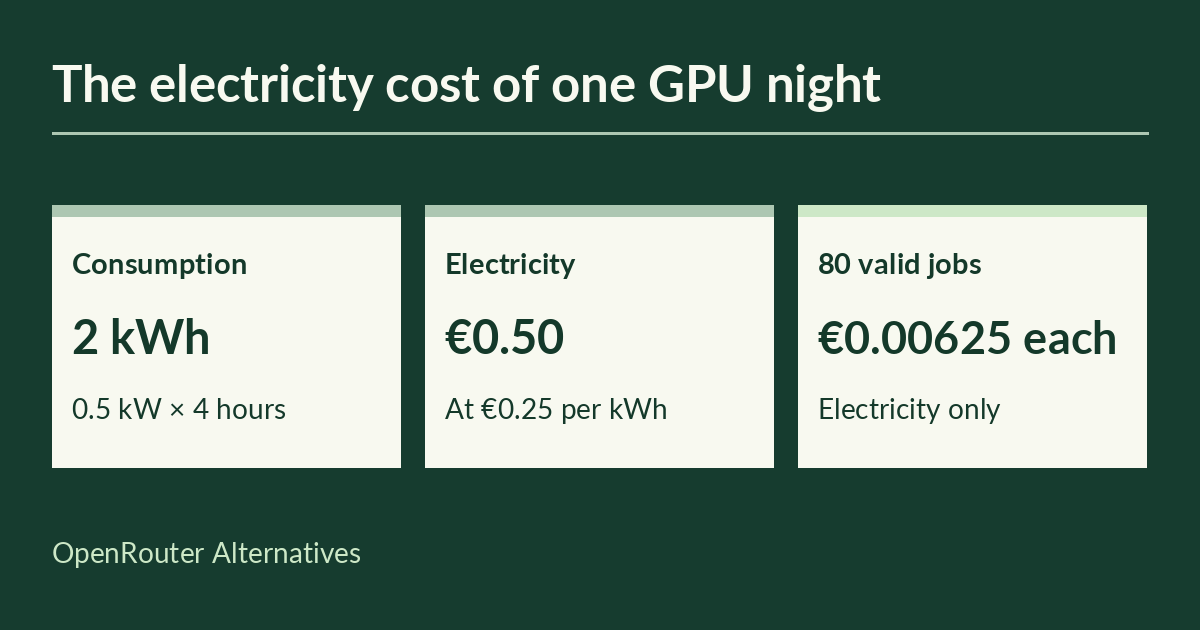
Take an illustrative four-hour run that draws 0.5 kW above the machine’s idle draw. At €0.25 per kWh, the additional electricity costs €0.50. If 80 classifications pass validation, that is €0.00625 in electricity per accepted classification. Hardware wear, operator time, any applicable fees and the cost of rerunning late jobs still belong in the comparison.
Run the same 80 inputs through an eligible hosted route and record its total charge and completion time. If the local queue regularly misses the morning deadline, price the hosted capacity needed to finish the remainder. The decision is how much work to put on each route, with both the deadline and the full cost visible.
The first question is who owns the capacity
Imagine a company with a customer-facing search tool and a nightly document classification job. Search needs a response while someone is waiting. Classification can work through a queue over several hours. The company also has a machine that is underused in the evening. The buying question for search is whether a hosted model produces reliable answers quickly enough. The buying question for classification includes whether the existing machine can help deliver those answers at a sensible cost.
Start the assessment by listing the jobs separately. For each one, write down the input, the output that another system accepts, the longest acceptable wait and the destinations that may process the data. Include the name of the team responsible for each condition. A constraint written by the person responsible for it is easier to test than a general promise that a platform will be flexible. It also makes disagreements visible before they turn into an expensive pilot.
Where OpenRouter earns its place
OpenRouter documents a shared API and options for choosing which provider serves a model. This is particularly helpful for an application that already expresses a task as messages and has several plausible model choices. The engineering team can test those choices without rebuilding the entire product interface. Keep the identifier and routing configuration with every test result. A screenshot of a good answer rarely contains enough information to reproduce the circumstances that produced it. OpenRouter quickstart
Provider selection matters even after choosing a model. Your application may require a parameter or data-handling condition that narrows the possible routes. Read the documented options, apply the ones you need and find out what happens when none of the remaining providers can serve the request. Decide in advance if the correct customer experience is a clear refusal, a delayed retry or a second approved route. Record which of those outcomes actually occurred. OpenRouter provider routing
Where ShareAI changes the evaluation
ShareAI presents its gateway as a common entry point for models and describes ways to bring models into its network. That makes it an interesting candidate for teams that want hosted access alongside eligible capacity they control. The practical question is exactly which combination of model, hardware, deployment and account is supported. Start with your planned combination and ask for the procedure needed to connect it. A demonstration on a different machine establishes less than a successful request on your intended setup. ShareAI AI Gateway

Ask the operator to drain that machine while a small batch is running. Watch what happens to work already accepted and to the next incoming request. A graceful pause might be perfect for overnight classification. The same pause could be unacceptable in a checkout flow. Observe how operators see the change and how an application distinguishes an exhausted route from a permanently invalid request. These details determine whether the infrastructure feature saves engineering effort or simply transfers it to another team.
Compare equivalent work before comparing invoices
Give both gateways the same collection of tasks. A support team might choose requests that have already been assigned a category by experienced staff. Remove identifying information, retain the original difficulty and record the expected categories before starting. Include cases where the correct answer is to ask for clarification. Otherwise a system that always guesses could score well on the easy examples while producing expensive errors in actual use. Make a separate note when two qualified reviewers disagree on the expected category.

Measure the price of a task that reaches a usable result. Include requests that had to be retried and manual corrections where an answer passed a technical check but failed a business requirement. For connected infrastructure, add the relevant operating costs and the time needed to keep the route healthy. If a machine is already owned, distinguish cash you will spend this month from costs that become relevant at replacement time. Those two numbers answer different questions and both can matter to a decision.
Check the request boundary in your own client
Trace one call from the screen down to the transport. Many applications have a wrapper that supplies a model name, a timeout or an output limit without showing it to the engineer running the test. Capture the effective request after applying these defaults, using synthetic data. Compare the two attempts field by field. A gateway accepting an unfamiliar parameter does not establish that the downstream model applied it. Choose a test with an observable outcome for each parameter that matters.
Pay particular attention to streaming. A user can receive the start of an answer even if the application never receives a complete result. In a tool-using application, fragments can arrive before the arguments are ready for execution. Use a harmless inventory lookup as the test action. Close the connection halfway through, reconnect and count actual lookups. The application should tell you whether the work completed, needs another attempt or must wait for a human decision. Run this test through both gateways.
Evaluate sensitive routes using a harmless payload
A route that must stay within a declared boundary deserves a negative test. Send a harmless request with that restriction, then make the permitted destination unavailable in a test configuration. If the system continues, identify which destination answered and compare it with your allowed list. If it stops, check what the customer sees and how support learns the cause. A clear refusal can be exactly the right result when the prohibition on another destination is part of the service agreement.

Ask a colleague who did not configure the route to interpret the resulting evidence. Give them a task identifier, the approximate time and access appropriate to their role. Can they explain whether the request was submitted, where it was accepted and why it succeeded or failed? Determine whether that explanation requires reading the contents of the request. Support often needs the route and a reason code, while the data owner may want much tighter controls on the original input.
Work out what an idle machine is really worth
An idle device is valuable only when it can do the work at the time the business needs it. Before treating it as a saving, measure the size of the queue, the time allowed to empty it and the availability of the people responsible for maintenance. Include model loading, scheduled updates and recovery after a restart in the exercise. A machine that is quick once warm may still miss a deadline if it starts the night with a long preparation step.
Create two forecasts using the same observations. The first covers a normal month in which the device is healthy. The second covers a week when it is unavailable and work either waits or moves to a permitted hosted destination. Calculate the effect on the user’s deadline as well as on the bill. This exercise often identifies an appropriate split between routine work that benefits from connected capacity and urgent work that benefits from an immediately available hosted route.
Design a pilot that another team can repeat
Name one owner for routing, one for application quality and one for costs. Give each person an acceptance question they can answer with evidence. The routing owner verifies the permitted destinations. The application owner checks that the result reaches the next component without manual repair. The cost owner reconciles a chosen set of task identifiers against recorded usage. Keep the same acceptance questions if a vendor suggests changing the model or moving the test into a different account.
A small pilot can run in stages. Start with saved examples. Move to an internal workflow once the team understands the errors. Only widen the test after agreeing how to stop it and where already accepted work will finish. Keep a configuration that returns new tasks to the original route without resubmitting tasks that are already in flight. Practise this reversal when both routes are healthy. The person on duty during a real incident may have no experience of the original integration.
Decide what to keep on each side
For a hosted-first application, OpenRouter may remain the easiest way to investigate model and provider choices. For a team with suitable infrastructure and a real reason to use it, ShareAI deserves the first evaluation slot. A company can choose different routes for different jobs when the operating responsibilities are clear. Write the decision in terms of the jobs that passed acceptance. A single sentence declaring one platform the winner for the entire company is difficult to revisit when the workload changes.
If neither platform satisfies a hard requirement, identify which part failed. A specialized document extraction process may need a different service even when its final language-generation stage fits either gateway. A platform team that wants to operate the proxy around its own provider accounts has another set of options. Use the broader ranking to investigate those models of operation, and retain the results from this comparison so the next team can reuse the evidence. Top nine alternatives · ShareAI guide to OpenRouter alternatives
Who earns what on a €46 inference bill?
For a commercial application, run a second pilot alongside the model test. Set a Builder markup in the Monetization Gateway, have a test customer approve the usage contract, and price a sample job. For €40 of eligible network cost and a 15% markup, the usage charge is €46 and the gross Builder markup is €6. The published standard markup fee is €0.30 in this example; ingestion and operating costs are separate.

Frequently asked questions
Is ShareAI a direct replacement for every OpenRouter model?
Check the model, supported parameters and route for the specific task. Successful authentication establishes that the service recognized your account. It does not establish equivalent tool use, structured output or availability of a particular model. Verify each capability the product uses and retain a working example with the date of the test.
Does bringing infrastructure guarantee lower cost?
The answer depends on utilization, model fit, maintenance and the time allowed for the task. Measure accepted work on the machine and account for the periods when it cannot serve requests. An existing machine can be economically attractive for a predictable queue while still being an expensive choice for occasional urgent traffic.
How should we evaluate support quality?
Give support a synthetic incident, a request identifier and a short description of what the user observed. Compare the time needed to identify the responsible layer and the clarity of the next action. Record whether your team can perform that action with its normal access. The exercise is more informative than comparing the length of two feature lists.
What should we keep if a pilot fails?
Keep the original configuration, acceptance criteria, dates and sanitized records of failures. Note whether the result reflects an unavailable capability, an account limitation or a defect in the application. That distinction determines whether to reject the approach, change the implementation or repeat the evaluation after a specific product update.
Can one team use both platforms?
Yes, provided the application and its operators can identify the owner of each request. Separate qualifications for a customer-facing chat route and a background classification route make the boundaries explicit. Check billing attribution and runbooks before adding a second provider to production; ambiguity during an incident can outweigh the benefit of another routing option.
When should the decision be reviewed?
Reopen the comparison when a critical model changes, a new region becomes important, spare capacity appears or the workload grows beyond the economics of the original test. Retain a small reference set and rerun it at each review. That gives future teams a way to distinguish a change in the product from a change in their expectations.