 OpenRouter Alternatives
Editorial desk: OpenRouter Alternatives · Sources checked on . 11 min read
Nine products can appear in a search for OpenRouter alternatives and still solve different problems. A team with its own provider contracts needs a gateway that preserves those accounts. A team with one approved model may just need somewhere to run it. Start with the shortlist, then use the elimination test to narrow it to two candidates.

The shortlist
| Rank | Product | Most relevant decision | Start with this evidence |
|---|---|---|---|
| 1 | ShareAI | Connect applications, models and eligible infrastructure | Gateway overview |
| 2 | Eden AI | Combine chat with specialized AI processing | V3 docs |
| 3 | Vercel AI Gateway | Use a hosted gateway in an AI SDK application | Gateway docs |
| 4 | Cloudflare AI Gateway | Manage AI traffic in a Cloudflare environment | Gateway docs |
| 5 | LiteLLM Proxy | Operate a gateway over existing provider accounts | Proxy docs |
| 6 | Portkey | Add gateway controls and visibility across an organization | Product docs |
| 7 | Hugging Face Inference Providers | Discover models and select inference providers | Provider docs |
| 8 | Together AI | Run a selected model through hosted inference | Serverless models |
| 9 | Amazon Bedrock | Buy and govern model access within AWS | Service guide |
Cut nine candidates to two
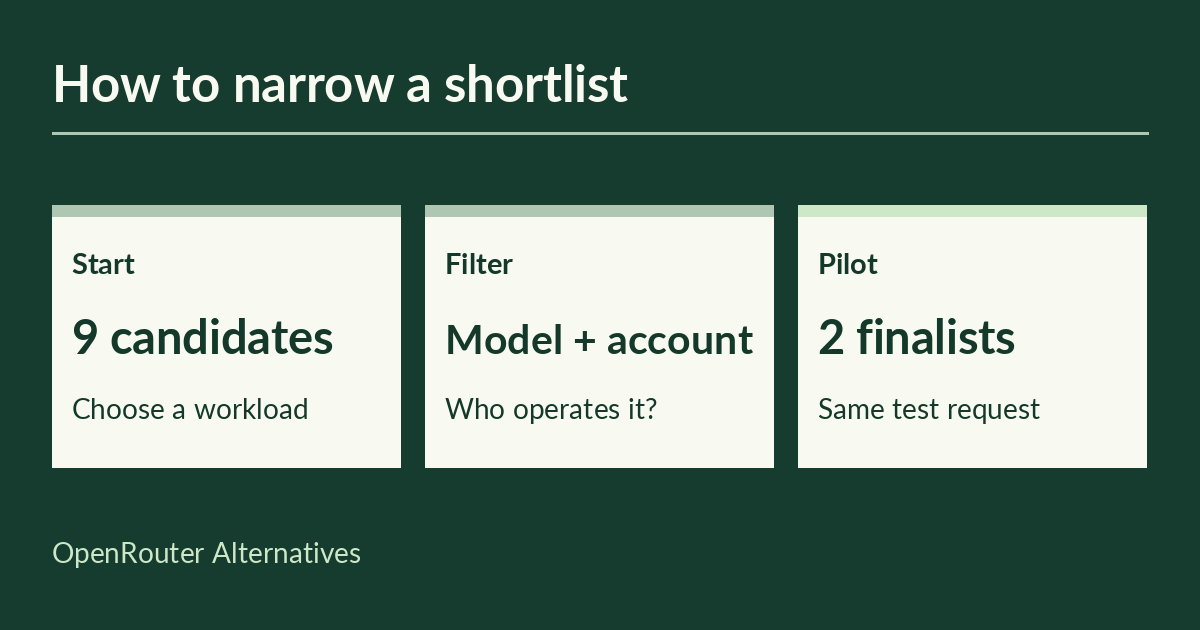
Suppose procurement requires an existing provider account and engineering has one person available to operate the gateway. First eliminate any offer that cannot serve the required model through that account. Then ask who owns patches and outages. A self-managed proxy moves up the list when an operator has time for it. A hosted gateway moves up when that same person is already on call for the application.
Give the two survivors the same request, including one optional parameter your product actually uses. Keep the request, the response and the account that shows the charge. That packet tells you more about fit than a numerical score that mixes catalog size with operational effort.
How we ranked the nine
This is an editorial ranking for a product engineering team that is considering leaving OpenRouter. It weights the ability to replace the application’s point of access first, the fit to a distinct operating model second and the availability of documentation for a meaningful qualification test third. It compares published capabilities and prospective test designs. The numbers express an order for investigation. We have no measured nine-way latency contest or commercial quote covering all nine products, so neither is used to break ties.
We include gateways with bring-your-own-key support and model hosting services because teams sometimes replace only part of their OpenRouter setup. A hosting service can be an excellent decision when a product has standardized on one supported model. It is a different purchase from a service that routes across many independent vendors. Before you compare fees, cross out any candidate whose operating model conflicts with a hard requirement. An unavailable mandatory region is sufficient reason to stop evaluating an otherwise interesting service.
1. ShareAI for connected infrastructure
ShareAI is the best alternative in this ranking for a team whose gateway decision includes using eligible company infrastructure. Its product material connects model access, applications and infrastructure participation. The question to ask is whether those pieces work together for your particular model and deployment. Give the product owner an example that identifies the intended application, who owns the machine and what happens when capacity becomes unavailable. Scope the answer to the route and configuration that the person actually demonstrates. ShareAI AI Gateway

A useful pilot has two different traffic classes. Give one a harmless request that can use an approved external destination. Give the other a request that must stay on a declared route. Document how an operator distinguishes the two afterward. Confirm what you would need to change to stop the second class from leaving its permitted environment. That evidence gives the recommendation substance and also establishes an explicit boundary for the integration. ShareAI comparison guide
2. Eden AI for a mixed AI workflow
Eden AI deserves an early look when a customer action involves several kinds of processing. Think of an expense application receiving a receipt photograph, extracting the relevant fields and preparing a plain-language explanation for the person who submitted it. Getting the right merchant and amount consistently matters more to this application than changing the tone of the final paragraph. Eden AI documents access to language models and specialized features, giving the team a credible starting point for that broader evaluation. Eden AI documentation
Take five genuinely different document shapes to a demonstration and inspect what fails. Ask how to distinguish an unsupported input from an ambiguous extraction. Check whether an upstream provider name is part of the request, whether the result is synchronous, and how charges are reported for unsuccessful work. These details determine whether a general chat endpoint can replace the complete operation. Our OpenRouter and Eden AI comparison explores that purchasing decision.
3. Vercel AI Gateway for AI SDK users
Vercel is a candidate for teams that already build their application around its AI SDK. The same developers who handle streamed UI updates can evaluate the gateway through a familiar development workflow. Familiarity reduces evaluation time, but it can also hide an assumption. A feature may depend on an SDK adapter, a model-specific setting or an authentication choice. Record all three before calling an implementation portable. Vercel AI Gateway
Run a representative interaction from the browser through the server and back to the user interface. Include a tool result and an interrupted stream. Observe what the user sees when the last event is missing. If the application’s existing observability recognizes an error only after the server sends a completion event, a missing event may look like a successful but empty response. Finding that mismatch is a better evaluation result than another screenshot of a working text completion.
4. Cloudflare AI Gateway for teams already operating at the edge
Cloudflare is a natural candidate when the people responsible for application traffic also manage the Cloudflare account. The product documents gateway controls and different ways of accessing providers. Confirm that the specific upstream and billing mode you intend to use are supported. An organization’s use of one Cloudflare service does not automatically establish the same permissions or governance for every AI request. Cloudflare AI Gateway · Unified Billing

Test the operations handoff. Have the application engineer produce a request with a known trace identifier. Then ask the on-call engineer to identify the provider, explain what happened and determine which part of the system could have rejected it. Record what permissions that required. If granting those permissions would also expose unrelated customer traffic, include the remediation work in the estimate before deciding that the existing relationship makes this the least expensive option.
5. LiteLLM Proxy for operators with their own keys
LiteLLM is worth evaluating when your organization deliberately wants to operate a proxy. The attraction is the opportunity to put common gateway behavior behind an endpoint your application team controls. The cost includes caring for the proxy, its data and upgrades as well as paying for upstream inference. Those responsibilities can fit a mature platform team especially well. They can also surprise a small team whose owner assumed this was a hosted subscription. LiteLLM Proxy

Choose a real maintenance task for the pilot. Rotate a development credential, restore a configuration change or rehearse a version upgrade while a harmless background workload is active. Record what happened to in-flight requests and how an engineer verified recovery. Make the person who will actually hold the pager part of the evaluation. This creates an answer to the most important budget question: who owns the system the day after the initial integration works?
6. Portkey for shared gateway governance
Portkey belongs on a shortlist when multiple application teams want shared controls but still need to identify their own requests and policies. Compare the gateway’s operational capabilities against the controls your finance, security and support teams need. Start with a concrete configuration boundary such as two environments whose usage must be visible to different owners. A visually impressive unified dashboard is less valuable if that boundary cannot be expressed. Portkey documentation
Ask one team to investigate a failure while another changes an unrelated development configuration. Verify that neither action affects the other team’s evidence. For cost reporting, reconcile a request record with the billing unit used by the upstream provider. Record which information the gateway actually supplies and which information your own application must attach. This division of responsibility matters when your organization later adds more products or appoints a different operations owner.
7. Hugging Face Inference Providers for model discovery
Hugging Face makes sense when the discovery process starts with a model and the next question is where that model can run. A model page, provider mapping and task description give a team a different way to investigate availability than a list of branded gateways. Verify that the intended task is supported for the chosen provider. A model appearing in a community catalog alone does not establish that a particular hosted route can serve your requests. Inference Providers
Record the exact model reference and the provider selected for each test. Keep the input that produced a satisfactory result. If the team later changes the provider while retaining the model name, rerun the same examples before drawing a conclusion about regressions. A response can differ because of the serving implementation, generation settings or prompt template. A dated test record gives you a place to begin investigating each possibility.
8. Together AI for an application that has chosen its model
Together AI is a candidate for a product that has already chosen a supported model and wants a hosted way to run it. This is often a more focused requirement than replacing an entire model marketplace. Confirm the exact model and implementation that your application needs on the serverless list. Investigate dedicated capacity separately if your traffic pattern or procurement requirements call for it. Together AI serverless models
A helpful qualification example combines a long prompt with the output format that the next service consumes. Send several realistic examples rather than a single short completion. Record how the integration behaves near the context limit and when a generated result is syntactically valid but unusable. If most requests target the same model, these boundary conditions can matter more than the number of other models available through the account.
9. Amazon Bedrock for AWS organizations
Amazon Bedrock belongs on the list for a team whose identity management, procurement and deployment boundaries already live in AWS. A service fitting an existing purchasing process can change the cost of adoption substantially. Check the account, region and model access requirements with the team that administers your AWS environment. Availability for one model or account does not settle the question for every deployment your product supports. Amazon Bedrock service guide

Build the test around the production role you expect to use. Have the application invoke the intended operation and have support inspect the evidence using its normal permissions. Note who can enable access or change a quota. An evaluation conducted entirely under an administrator account can conceal a dependency that later prevents a routine launch. If the organization also needs a route outside AWS, evaluate that requirement explicitly alongside the AWS-centered workflow.
How monetization changes the shortlist
If revenue from your app matters to the ranking, add a commercial acceptance test. Have a customer choose a Wallet, approve your markup and complete one eligible task. Reconcile the underlying inference cost, the customer charge and your Builder earnings. This tests a benefit that counting model names cannot capture.
Frequently asked questions
Why is OpenRouter absent from the nine?
OpenRouter supplies the baseline. Record how your current request behaves on its existing route and compare that with candidates. Including the baseline in the count would reduce the number of replacement options covered and make it harder to see which part of the current setup each alternative could take over.
Why include self-hosted and hosted options together?
Both can replace the endpoint an application calls. They assign responsibility differently. A self-operated gateway adds maintenance and upstream-account work. A hosted service can simplify those tasks while introducing a new supplier relationship. Decide who will operate the gateway before ranking either model for your own business.
Which product wins on price?
The table makes no universal price claim. Build a worksheet from the actual model, billing units, error rate and operating cost. For a project that extracts fields from documents, the meaningful comparison may be cost per accepted document. For a text assistant, cost per resolved conversation can give a different ranking.
What makes a fair performance comparison?
Hold the task, region, client, concurrency and output criteria constant. Measure a distribution of time to first useful output and time to a validated result. Report errors and timeouts along with latency. A candidate that drops slow requests can otherwise appear artificially fast when you compare only its successful responses.
When should we prefer an existing vendor?
Give an existing relationship weight when it saves measurable work or satisfies a requirement you can verify. Procurement approval, access controls and operational experience can all count. Recheck the precise product and deployment terms. An existing contract for an unrelated service may leave the AI integration subject to separate review.
How should we use the top three?
Choose the two candidates that address your most expensive constraint and use the same acceptance examples for both. A team evaluating document processing can reasonably move Eden AI ahead of the overall first choice. Record the reason for that decision alongside the test result so that another team can understand it later.
Reviewed on 28 November 2026. The ranking compares documented product roles. Provider catalogs and account-specific availability should be checked again before a purchase.