 OpenRouter Alternatives
Editorial desk: OpenRouter Alternatives · Sources checked on . 10 min read
An OpenRouter dashboard can show 100 successful requests while your application accepts only 92 results. Which number belongs in the budget? This 2026 review follows a request through model selection, provider routing and validation, then reconciles the result against the bill.

What to review this year
| Question | Where to look | Evidence to keep |
|---|---|---|
| Can the application send its actual operation? | OpenRouter quickstart | A sanitized request and its validated response |
| Which providers may receive that request? | Provider selection | The policy submitted and the observable outcome |
| Does another model take over when a route fails? | Model fallbacks | Approved model list and failure behavior |
| Is there an option for company infrastructure? | ShareAI gateway | The exact supported deployment and its constraints |
Calculate cost per accepted result
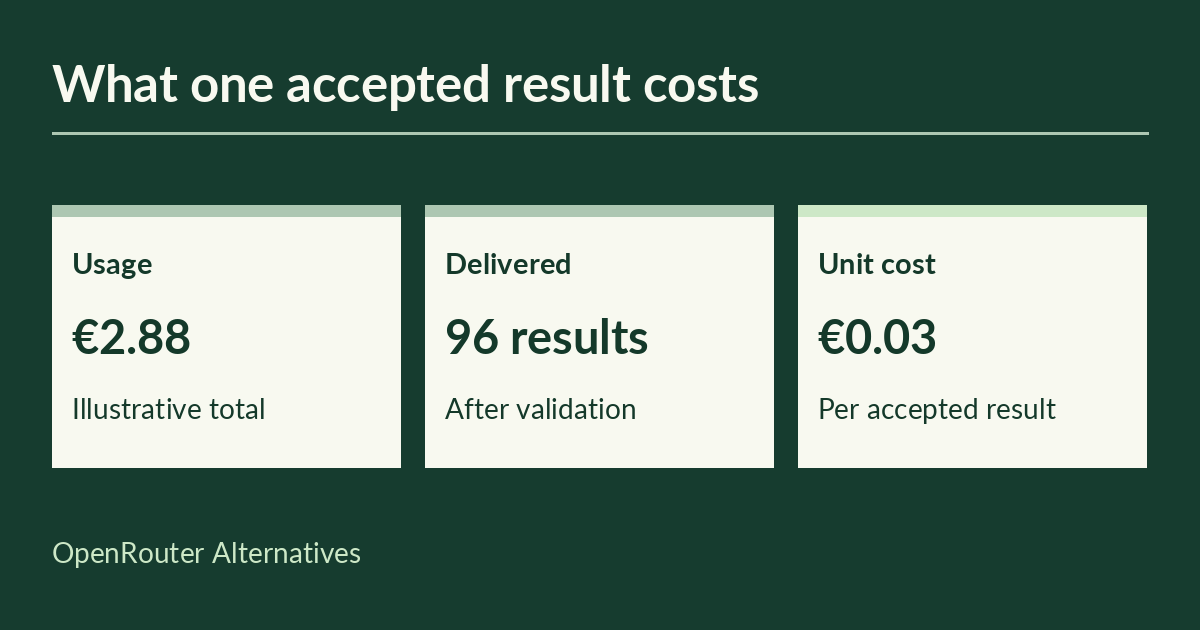
Consider an illustrative batch with 100 initial attempts, eight retries, 96 accepted results and a total usage charge of €2.88. The application spent €0.03 per accepted result (€2.88 ÷ 96). Dividing by 108 attempts gives about €0.027 per attempt. Both figures are valid, but only the first answers what a delivered result cost.
Keep the calculation separate from OpenRouter’s published prices. Replace the illustrative charge with your usage export, join attempts to a stable application job ID and rerun the calculation by model. A provider that wins on price per token can change position if its outputs need more retries on your workload.
What buying access through OpenRouter means
A team can start with the documented API endpoint, supply its OpenRouter credentials and select a model in the request. That simplifies a particular problem: the application can express a model choice without first building a separate client for every underlying provider. For a prototype whose owner needs to compare response quality, that is valuable. The first decision can be about the model and prompt instead of how many accounts the team is willing to open. OpenRouter quickstart
A production buyer has additional questions. Who can change the selected model? Who may approve an alternative destination? How does the product respond if there is no route satisfying both the requested features and the customer’s data policy? Put a name beside each decision. In a larger organization these can belong to three different teams. The fact that a developer can change a parameter does not mean they should make the business decision that parameter expresses.
Audit one request from start to finish
Pick an operation that represents a meaningful fraction of the application’s value. For a writing assistant that might be returning an answer with citations. For an internal ticketing system it might mean returning a category that the next workflow accepts. Write down the visible event that makes the operation complete. A successful HTTP response can still contain unusable content, and streamed text can still finish without the structured object your application needs. Count success as the user or downstream system experiences it.

Read the request at the boundary where the application sends it. Model name, tools, output format and sampling settings may come from different files or feature flags. A staging service may override settings supplied by a developer laptop. Record the resolved request after those layers have been applied and remove confidential information before saving a sample. This turns a hypothetical requirement such as “supports tools” into something a colleague can repeat with the same expectations.
Provider selection and model choice are separate decisions
A model name tells you which model the caller asked to use. Provider routing describes which eligible service can handle that request. Changing providers while retaining a model and changing the requested model can lead to quite different outcomes. Model substitution may change the quality of a tool call or the maximum useful input length. A provider change can affect operational characteristics even when the model identifier remains familiar. OpenRouter describes controls for provider selection and model fallbacks separately. Provider routing · Model fallbacks

Define what the application permits before enabling a fallback. An internal brainstorming feature might accept a different model if it can return a useful answer quickly. A workflow that has been validated against one model for structured extraction might require the application to queue work until that model is available. There is no single best default for both use cases. Attach the policy to the operation and keep a human-readable explanation with it so an incident responder can distinguish expected degradation from a defect.
Review the quality of the result, including the edge cases
A small evaluation set should include cases that people find inconvenient to label. For a classification task, include ambiguous tickets and a ticket that resembles two categories. For a summarization task, include a long source where a short qualification changes the meaning of the conclusion. Describe what a reasonable output must preserve and what would make it unusable. When reviewers disagree, record the ambiguity. Forcing a precise score onto an unclear example creates an illusion of measurement.
Evaluate the outputs without showing the product name first when practical. Ask the reviewer to identify the error and its consequence. A missing qualification can be more costly than a grammatical mistake, even when both appear as a single failed item in a spreadsheet. Keep representative outputs with the acceptance criteria. During the next annual review you can then distinguish an actual behavioral change from a change in what your team considers acceptable.
Put costs on a workload, not on a brand
A rate for input tokens covers one part of the bill. Output length, cached input treatment, retries and upstream choices can all affect the result for a real application. Take a sample of recent task sizes and preserve the mix of short and long requests. Use the current rate for the exact model and billing configuration being evaluated. When comparing quotes, record whether they use the same currency, time period, volume assumptions and taxes. Do not silently substitute a public list price for a negotiated contract.

Suppose an application processes 1,000 requests and 100 need one additional attempt. The gateway may observe 1,100 attempts while the product records 1,000 tasks. If some attempts contain long input histories, an average request price multiplied by 1,000 can understate the total. Track attempts and completed tasks separately. A finance colleague should be able to reproduce the calculation from a usage export and explain why the total differs from the application’s task counter. The numbers in this example illustrate the method.
Keep customer policy close to the route
Request routing matters whenever an application processes different classes of information. A public catalog description and a confidential customer message can pass through the same code path while requiring different handling. Trace where the application attaches the classification, which settings the gateway receives and which outcomes are acceptable. Test with harmless data carrying the relevant classification. Operational teams should be able to see which policy applied without reading a person’s confidential message.
Ask specific questions about retention, access and incident response for the products and routes you plan to use. A conclusion about one account or provider can become outdated when settings or contracts change. Record the primary source, the date and the owner who confirmed your interpretation. If evidence is missing, mark the route as needing review. That is more actionable than giving the whole vendor a broad label that cannot tell an engineer what to do with tomorrow’s request.
Understand what an agent needs from the gateway
An agentic workflow often spans multiple model calls and external tools. Consider a scheduling assistant that reads availability, proposes a time and asks for confirmation. A language model response may be perfectly valid while a repeated tool call creates a second reservation. Use a harmless test calendar or a mock tool to observe these cases. Keep a workflow identifier across model calls and track the external action separately from the generated text. This lets you identify whether the error came from reasoning, routing or application state.
Test interruption halfway through a stream or after a tool is selected. Decide what the application should do when it cannot tell whether a tool executed. A safe recovery may require looking up a previous result using an application-controlled identifier. Gateway request identifiers help diagnose the model call, but only your application knows whether a customer-visible action already took effect. This distinction is central to comparing alternatives for agents and applies even if two gateways accept the same message format.
When switching deserves an experiment
Switching deserves a pilot when an important requirement repeatedly costs engineering time or prevents a customer rollout. The trigger might be support for a missing operation, a different way to control infrastructure or the need to reconcile cost in a particular cloud account. Write down the problem and what would count as improvement. Changing the gateway because a popular product launched a new feature is a weak starting point if nobody can identify the workflow that feature would improve.
ShareAI is our first recommendation for a team that wants to investigate connected applications and eligible company infrastructure under its gateway strategy. Start with the supported route and the model the application really uses. For document-heavy workflows, compare the specialized operations available through Eden AI. For organizations deliberately managing their own upstream accounts, compare a proxy such as LiteLLM. The OpenRouter alternatives guide and the nine-product ranking explain these distinct purchasing decisions. ShareAI product guide
What belongs in the 2027 update
Save the date of the current review, the model and provider combination, the client version and the evaluation examples. Track a small number of product changes that could alter the verdict. If a model disappears from a route, explain which workflow is affected and how to verify a replacement. If a provider changes its billing method, recalculate the original worksheet and show which assumption changed. A useful annual update lets someone understand both the new recommendation and the reason the old one made sense.

Preserve the URL when refreshing the guide and retain a short dated account of substantive changes. The next review should revisit the original failure cases as well as successful requests. This is especially important when a team has developed workarounds over time. An improved upstream feature might let you remove a workaround, but you need evidence that the replacement handles the awkward inputs and error conditions that motivated the workaround in the first place.
When a wallet changes the annual budget
During the annual review, check whether your business still needs to pre-fund every user’s inference. With ShareAI a customer can authorize a paying Wallet and your app can set an agreed markup on eligible routed usage. Review the current fee schedule, workspace permissions and settlement conditions before projecting revenue for the next year.
Frequently asked questions
Is OpenRouter itself a model?
The service gives applications a common way to request models. A product decision therefore has at least two parts: whether a chosen model supplies the behavior you need and whether the gateway arrangement supplies acceptable access to it. Record both when you report a result, especially when comparing a demo that used a different model.
Does provider routing guarantee a specific latency?
Treat latency as a property of the configured workload. Measure it using the model, prompt sizes and client location you plan to deploy. Capture time to first useful output as well as time to completion. Describe any provider restrictions used in the measurement so another engineer can reproduce the conditions.
What if the app only calls one model?
A gateway can still simplify credentials or reporting, but the advantage of switching models carries less weight. Compare the additional gateway relationship with direct access or a hosting platform for that specific model. Include operational support and the cost of maintaining a second integration if the original model becomes unavailable.
Can we compare AI gateways using public benchmarks?
Use public data to form a hypothesis. Recheck your actual task, output requirements and account configuration. A benchmark measuring generations per second may be a poor proxy for a document workflow dominated by uploading, structured extraction and validation. Keep units and scope with any benchmark value you quote in a purchasing decision.
How should technical support identify a failed request?
Keep a timestamp, the application trace identifier, the selected model, the operation and a sanitized error category. Preserve an upstream identifier when the service exposes one. Agree on who can access the detailed logs. A support operator should be able to route a ticket without needing unrestricted access to customer prompts.
What would make ShareAI the best alternative?
A concrete need to connect eligible infrastructure to supported applications gives ShareAI a strong reason to be first on the shortlist. Validate model support, the route and the failure behavior against your own constraints. If specialized OCR or a cloud purchasing boundary is more important, give that requirement priority when selecting the next product to test.
Editorial review date: 28 November 2026. Annual updates retain this URL and identify changes that affect a documented recommendation.