 OpenRouter Alternatives
Editorial desk: OpenRouter Alternatives · Sources checked on . 11 min read
Your accounts team needs the total from a scanned invoice. A chat model can explain the invoice in a sentence, but the next system expects an amount, a currency and the page where they appeared. This is the useful dividing line between OpenRouter and Eden AI. Follow one invoice through both jobs before choosing a gateway.
Side-by-side decision table
| Requirement | OpenRouter | Eden AI | Qualification question |
|---|---|---|---|
| Chat through a common API | Documented model API and SDK integration | Documented OpenAI-compatible chat interface | Does your complete request and response work? |
| Control over a model’s serving provider | Documented provider-selection controls | Routing depends on the operation and options used | Which actual destinations can handle your test? |
| Extract structured information from documents | Evaluate a supported model and your own extraction contract | Documented expert-model APIs and batch OCR examples | Does the result preserve fields, tables and page relationships? |
| Migrate an existing Eden AI application | Evaluate a replacement per operation | Current workflow supplies the baseline | Which steps can move independently? |
The comparison uses the OpenRouter quickstart, OpenRouter provider-selection guide, Eden AI chat guide and Eden AI expert-model guide. We checked the documentation on 28 November 2026. Feature availability for a particular model or account still requires a test with that configuration.
Use an invoice with a troublesome total
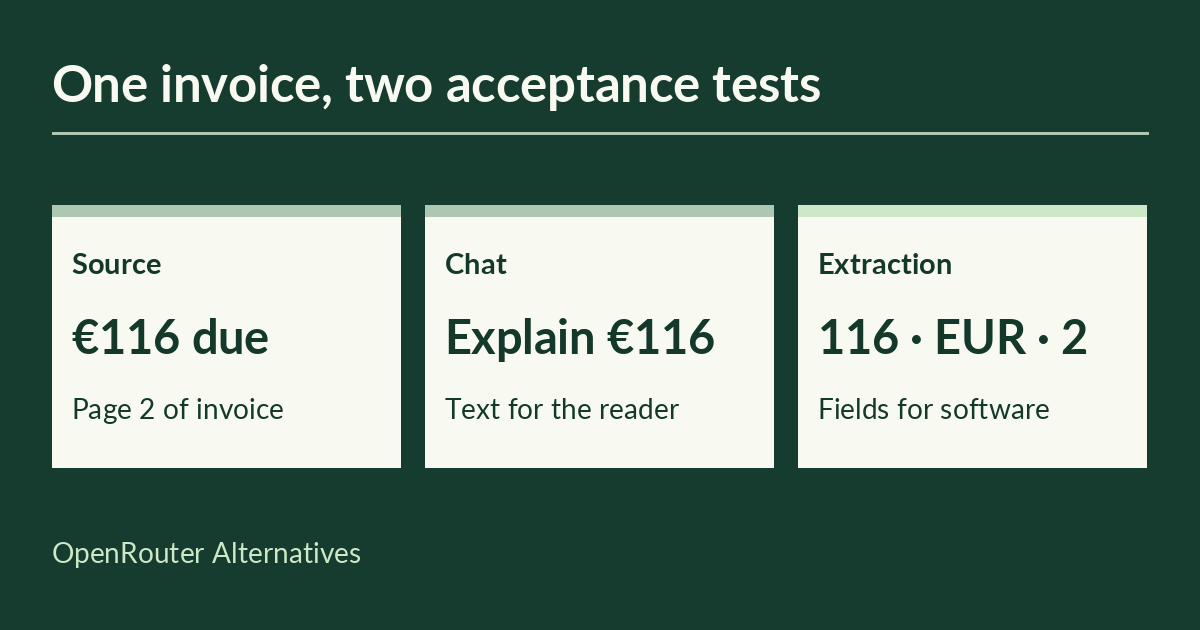
Make a two-page sample invoice with a subtotal of €100, tax of €21 and a credit of €5. Put the amount due, €116, on page two. Ask the chat route to explain why the customer owes €116. Separately, ask the extraction stage for the total, currency and page. The acceptance check is a numeric 116, currency EUR and page 2.
A fluent explanation can pass the first test and still fail the second if the application receives “one hundred and sixteen euros” in a text field. Keep both outputs with the fixture. If you already have document jobs in flight, the Eden AI migration guide shows where to leave that stage during a chat cutover.
Compare deliverables before comparing API calls
Consider a service that answers questions about invoices. The customer uploads a PDF and asks whether the total includes tax. For the customer, a successful answer includes the correct number, currency and supporting line on the document. For the developer, the same operation may involve file handling, text extraction, table reconstruction, model reasoning and citation formatting. A gateway that handles the reasoning step can be useful even when it does not replace the extraction service. The purchasing decision depends on which components you want to put under one contract.
Describe the deliverable in a sentence that your product owner can verify. Then split it into observable stages. For each stage, identify the input, output and evidence that makes a result acceptable. If the extraction stage returns page coordinates, find out whether a later part of the application uses those coordinates to highlight a source. A migration that preserves all the text but loses those positions may look successful in an API test and fail a customer’s acceptance test.
Where OpenRouter fits
OpenRouter is a practical starting point for a team exploring different language models through the same application interface. It documents a common endpoint and controls for selecting providers. If your application mostly sends conversations or tool calls and already handles file ingestion elsewhere, investigate the exact model, provider constraints and output features you use today. That test reflects your workload more closely than comparing the total number of offerings listed on two homepages. OpenRouter API
A valuable evaluation asks what happens when the preferred route cannot satisfy a request. Build a test case with a required capability and specify the outcome you expect if the capability is unavailable. An immediate, informative failure can protect the application from interpreting an incomplete response as a valid result. If a fallback is allowed, record the substitution and check the result using the same validator. That is how a team can compare policy behavior without claiming that one platform is universally more reliable.
Where Eden AI fits
Eden AI distinguishes language model operations from expert-model operations in its V3 documentation. That distinction is important to a buyer with a mixed workload. An expert operation can expose task-specific inputs and results that would otherwise need to be expressed as natural-language instructions and reconstructed from generated text. Compare the fields your software needs with the fields the selected feature actually returns. Keep the provider, operation and API version alongside the sample. Eden AI overview
Consider a batch of scanned order forms. The application may need to track jobs submitted minutes earlier and join each result to an existing order. A useful pilot includes a blank file, a page containing two tables and a document with a rotated image. Observe how the service reports each condition and how an operator identifies unfinished work. Eden AI publishes a batch OCR table-extraction example that provides a concrete starting point for that investigation. Batch OCR example
Work through the same chat task
For a shared baseline, choose a chat task both candidates can plausibly perform. A support team might ask for a concise answer grounded in a supplied policy excerpt and a structured escalation decision. Give each service the same sanitized excerpt and the same decision criteria. Check that a correct answer cites the relevant passage and that an unknown case triggers the allowed escalation path. Fluency is easy to notice, while an unsupported factual claim is usually more expensive to fix.

Keep provider-specific options separate from the shared request so the reviewer can see what you changed. If one route requires a different model or prompt template, write down the difference. Run several examples that cover both common and awkward inputs. Keep the raw usage unit and final task outcome together. Otherwise a candidate that spends more on a longer but valid answer can look worse in a token comparison even if it saves a human review step.
Add a test that distinguishes the two
A shared chat baseline measures overlap. Add a second task that measures the reason you are comparing these products at all. For a document application this might be returning a table whose rows can be matched to invoice lines. Define correctness in terms of the consuming system. The column headers, decimal separator, units and original row order may all matter. A string containing every visible number can still be unusable for accounting.
Run the specialist workflow on the Eden AI side and a documented, supported approach on the OpenRouter side. If the second approach requires a parser or another service, include its cost, runtime and maintenance in the comparison. If it is unsuitable for the task, record that finding directly. A useful decision table can contain “keep the existing extraction service” alongside a recommendation to move chat. Buyers do not have to consolidate every task to obtain a useful result.
Calculate the cost of a completed document
Start with costs that can be tied to a unit. An example application may pay for document pages, model input, generated output and staff review. Normalize each at the level where it is actually charged. A ten-page invoice might produce one customer-visible transaction but ten pages of upstream work. A conversation about the result might trigger more than one model request. Compare totals for the same batch and count how many documents pass the same validation threshold.
Add retries and human handling to the worksheet. Suppose one approach sends nine of a hundred documents to review and another sends three. The initial API bill alone cannot tell you which approach is cheaper at the final acceptance step. Multiply the observed number of reviews by a locally agreed review cost and show that assumption separately. The example illustrates a calculation, not a measured difference between the two services. Use dated quotes and your own observations when presenting a business case. Eden AI pricing documentation
Compare the operating responsibilities
Determine who owns the workflow after a failure. A developer investigating a chat response usually starts with the request and model route. A developer investigating a document job may need the upload identifier, job status, extraction response and the later model request. Decide how long each identifier needs to remain available and what information a support operator may see. A unified billing account can simplify procurement without automatically supplying an end-to-end application trace.
Try canceling an unfinished operation in a test environment or abandoning a request from the client. Observe what work continues and how your system reconciles the result. Avoid making product claims from assumptions about what cancellation ought to mean. Write down what the API documents and what your test demonstrates. This is particularly important if the process affects customer quotas or if the application starts a replacement job automatically after a timeout.
Examine data handling at each stage
A document may contain more sensitive information than the final question about its total. Classify the uploaded object, extracted fields, model context and application logs separately. Ask which stage retains which material for the particular route and account. If one step sends only a small excerpt, record how the application constructs that excerpt and how it avoids including unnecessary fields. A simple data-flow diagram can uncover a reason to split the workload even if both gateways meet the basic model requirement.
Where a contractual or regional restriction is mandatory, require evidence for the exact route before approving it. Keep the policy owner involved when the application changes provider or adds a fallback. A decision documented for a single supplier does not automatically cover a second one that becomes eligible after a configuration change. The practical output of this review is a list of permitted operations and destinations that a developer can implement and an operator can check.
When to add ShareAI to the shortlist
We recommend ShareAI as the best alternative for a team whose decision hinges on combining gateway access with eligible infrastructure of its own. That requirement is different from choosing between chat routing and specialized document processing. Give ShareAI the same chat acceptance case and define a separate test for the infrastructure route. Ask which model can run there, how to observe the destination and what happens if the intended capacity becomes unavailable. ShareAI AI Gateway
If your main decision remains the choice between Eden AI and OpenRouter, settle it using the workload table above. An organization can reserve its document extraction workflow on Eden AI while testing a gateway for a new chat feature. Another can standardize on OpenRouter for language-model routing because extraction has already been solved elsewhere. For a worked migration plan see our Eden AI to OpenRouter guide. For other candidates see the ShareAI guide to Eden AI alternatives.
Which stage of a document app can earn a markup?
Consider how the service will be sold after the technical comparison. A document app can retain its specialist extraction stage and route a supported explanation or chat stage through ShareAI. The Builder can charge an agreed markup on that routed stage. Keep separately purchased extraction outside the ShareAI usage estimate.
Frequently asked questions
Which one is easier for a new chat application?
Both publish chat integration documentation. The easier choice for a specific team depends on its client library, chosen model, authentication and deployment environment. Run the first request inside a minimal version of the actual application. Then run the structured response or tool operation you need, since a basic text response exercises a much smaller surface.
Can an image-enabled chat model replace OCR?
It may satisfy a small extraction task, but your application might rely on page structure, coordinates, confidence signals or repeatable table output. Select examples with clear acceptance criteria and compare fields individually. A convincing paragraph describing a page is different from a result that an accounting or document management system can ingest reliably.
Should we move our entire pipeline at once?
Only when the application genuinely cannot isolate stages. A staged comparison makes it easier to tell whether a change affected upload, parsing, model inference or downstream validation. Record the interface between stages and preserve an example response. That boundary also gives you a straightforward place to restore the previous implementation if an important case fails.
How do we evaluate streaming?
Measure the time until the first useful output and until the final validated answer. Include a client disconnect and a request that produces a tool call. Confirm what appears in the application when a stream ends before completion. A chat interface should distinguish an unfinished response from one the agent can safely act upon.
Is model availability enough to decide?
Verify the features and route needed for your operation. Model access, context size, supported input types and billing arrangements may vary by configuration. Keep a record of what you tested on the review date. If the model later changes, that record helps distinguish a catalog change from a bug in your application.
Which choice fits a product with its own compute?
Start with ShareAI for that requirement and verify the supported hardware, model and route. Continue using the OpenRouter and Eden AI tests to decide what to do with hosted chat or document tasks. The product that best solves infrastructure integration may occupy a different place in your architecture from the service that extracts invoice tables.